
What the data actually tell us
In recent weeks, headlines have reignited a question that often comes up when we talk about young people and alcohol: Is Gen Z really more sober than previous generations?
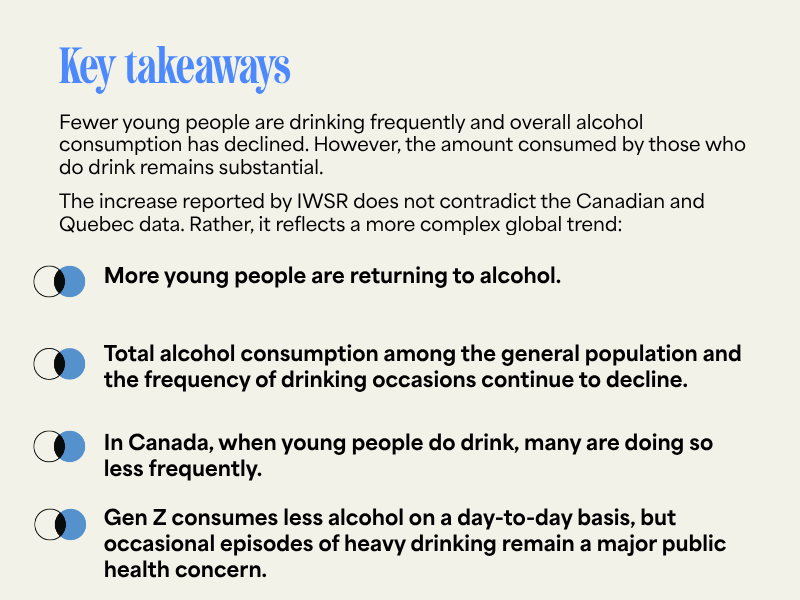
Drawing on data from a study by British firm IWSR, which surveyed more than 32,000 people in 19 countries, some media outlets were quick to conclude that the idea of a more sober generation is a myth. Young adults, they suggested, now drink just as much as their elders.
But an important question deserves more than a snap conclusion. Let’s take a closer look at why the actual numbers don’t support such a categorical answer.
Putting the headlines to the test: What does the IWSR study actually say?
IWSR is a legitimate and well-established company that has specialized in market analysis and intelligence for the global beverage industry for more than 50 years.
The study in question comes from Bevtrac, IWSR’s twice-yearly survey. Among its findings:
- 76% of all adults surveyed had consumed alcohol in the previous six months.
- 74% of legal-drinking-age Gen Z adults had done the same.
- This represents an increase among Gen Z compared with three years ago (66%).
The quick conclusion would be: Gen Z drinks as much as everyone else, so moderation among young people is a myth.
Why this analysis is incomplete
A single statistic doesn’t tell the whole story:
- Prevalence tells us nothing about quantity: Having consumed at least one alcoholic drink in the previous six months tells us nothing about how often someone drinks, how much they drink, episodes of heavy drinking or the number of alcohol-free days.
- Statistical significance matters: A two-percentage-point difference (74% versus 76%) does not allow us to conclude that Gen Z has the same risk profile as older generations. Without access to the overall margin of error for the sub-sample or to confidence intervals, caution is warranted.
- Local context matters: The study combines international data from countries where the legal drinking age varies and where drinking cultures are very different. Its findings do not automatically reflect the reality in Quebec or Canada.
What do Canadian and Quebec data tell us?
When we turn to representative national and provincial surveys, the picture becomes more nuanced and informative.
According to Statistics Canada data (2024 analysis covering 2015–2024):
- Non-drinking is on the rise: The proportion of people who had not consumed alcohol in the previous 12 months increased from 2015 (23%) to 2024 (29%).
- Drinking frequency is declining among people who drink, particularly those aged 18–34 : the proportion of adult drinkers reporting that they drink alcohol less than once a month increasing from 20% in 2015 to 27% in 2024
- Real and persistent risks remain: Among younger regular drinkers, however, heavy drinking has returned to pre-pandemic levels.
In Quebec, according to the INSPQ:
A combined analysis of population surveys and alcohol sales data shows that:
- Alcohol consumption in Quebec fell by 13% between 2021–22 and 2024–25.
- Approximately 83% of people aged 18–24 had consumed alcohol in the previous year in 2021.
- Among people who drink alcohol, 30% reported episodes of heavy drinking, with this behaviour more common among 18–44-year-olds (between 34% and 37%).
👉 To consult INSPQ data on trends in alcohol consumption among secondary school students (in French only)
👉 To consult Statistics Canada data on changes in alcohol consumption from 2015 to 2024.
A critical look at the headlines
To properly interpret news about alcohol consumption and health, it’s important to keep a few questions in mind:
The source: Is this a commercial opinion survey or a public health study based on a representative sample?
The indicators: Does it measure simple “participation” (having had a drink once in the past year) or does it measure frequency and quantity?
The region: Do the data describe a global average or the reality of our communities here in Quebec?
The margin of error: Is the observed difference statistically significant or could it simply reflect normal statistical variation?
Asking these questions helps us move beyond simplistic “myth or reality” narratives and better understand the real education and prevention needs of young people when it comes to their health.