
Quebec Summit on Alcohol and Health
FAVORIBookmark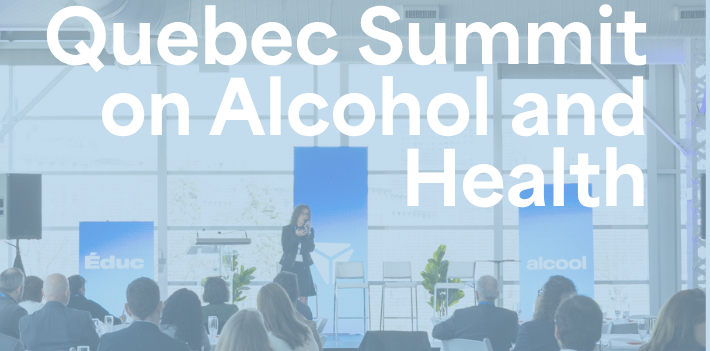
What the Science Says.
How to Communicate It.
First Quebec summit on Alcohol and Health
Why organize the Summit?
In January 2023, the Canadian Centre on Substance Use and Addiction (CCSA) updated Canada’s Guidance on Alcohol and Health, lowering the “low-risk” threshold to two standard drinks per week for the population as a whole, based on the principle that there is no level of alcohol consumption that is completely risk-free.
This shift stands in stark contrast to the 2011 guidelines (up to 10 drinks per week for women and 15 for men), as well as to more permissive positions adopted elsewhere in the world. The World Health Organization (WHO), for its part, follows the principle that no level of alcohol consumption is risk-free. Against this backdrop, the Summit seeks to foster informed dialogue about these changes and support clear, nuanced public communication adapted to the Quebec context.
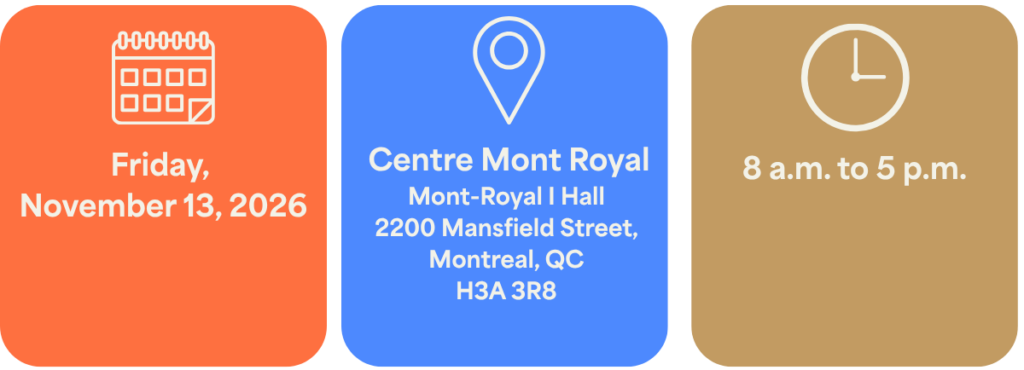
The Quebec Summit on Alcohol and Health, the first of its kind organized by Éduc’alcool, will take place in Montreal on November 13, 2026. It aims to create a space for dialogue among experts, decision-makers, professionals and members of the public on recommendations around alcohol consumption and how they are communicated to the public.
The day’s program is designed to encourage learning and discussion around alcohol and health. In the morning, experts will explore the theme “Alcohol Consumption Guidelines and the Question of Low Risk.” In the afternoon, four structured thematic discussions will provide an opportunity to examine key findings, barriers and opportunities, as well as recommendations for promoting responsible approaches to alcohol in student, event and hospitality settings. A final workshop will focus on how to communicate and explain scientific research to the public.

Schedule
Morning
| Time | Activity | |
| 8:00 | Registration and welcome Healthy breakfast available in the welcome area | |
| 8:50 | Opening of the day | |
| 9:00 | Welcome remarks | Josée Côté, M.A., Adm.A.: Executive Director, Éduc’alcool Yvan Gendron, MAP, ASC: Chairman, Éduc’alcool |
| 9:10 | Remarks by the guest of honour | |
| 9:25 | Presentation by | Dr. Denis Soulières Scientific and Medical Spokesperson, Canadian Cancer Society |
| 10:10 | Panel discussion “Alcohol Consumption Guidelines and the Question of Low Risk” | Guest experts: Adam Sherk, PhD, Senior Scientist and Special Policy Advisor, Canadian Centre on Substance Use and Addiction (CCSA); Associate Professor, School of Public Health and Social Policy, University of Victoria Jean-Sébastien Fallu, PhD, Full Professor, School of Psychoeducation, Université de Montréal; Editor-in-Chief, Drogues, santé et société Joël Tremblay, Ph. D.: Senior Researcher, IUD; Full Professor, Department of Psychoeducation, Université du Québec à Trois-Rivières Moderator: Christine Stich, PhD, public health Specialist, Scientific Advisor, Éduc’alcool |
Afternoon
| 11:50 | Intro to no alcooloc cocktails workshop | Animation by Drink NOA · partner of the Summit |
| 12:20 | Lunch provided | |
| 1:40 | Workshop 1: Alcohol in student settings (tools, best practices), Health promotion, prevention, intervention, harm reduction, etc. Workshop 2: Responsibility around alcohol in the hospitality sector. From communication to practice: changing practices in the hospitality sector. Workshop 3: From science to communication. Explaining the facts and having an impact. Workshop 4: Responsibility around alcohol at events. How to organize responsible events. | Workshop facilitators: Anne-Elizabeth Lapointe: Executive Director, Maison Jean Lapointe · Workshop 1 Cassandre Boisselle-Pitre, BBA: Master’s student in International Economics, HEC Montréal; Co-founder, HEC 360, and Chloé Gagné-Laviolette, BAA: Social Work Technician | Double Bachelor of Business Administration Student, HEC Montréal | Public Relations Coordinator, HEC 360 · Workshop 1 Maxime Coubès, mixologist, cocktails expert, National Brand Lead, and Philippe Castonguay: mixologist, cocktails expert, Head of Operations and Marketing, Drink NOA · Workshop 2 Ariane Bélanger-Gravel, Ph.D.: Full Professor, Department of Information and Communication; Regular Researcher, NUTRISS-INAF Research Centre, Université Laval · Workshop 3 Jean-Sébastien Fallu, PhD, Full Professor, School of Psychoeducation, Université de Montréal; Editor-in-Chief, Drogues, santé et société · Workshop 3 Maritchou Plamondon: President and CEO, and Joannie Langevin: Director of Development and Outreach, OPC ÉVÉNEMENT · Workshop 4 Marilou Lapointe: Founder and co-owner Apéro à zéro · Workshop 4 Luc Rousseau: CEO, Concept B · Workshop 4 |
| 3:20 | Networking and wellness break | |
| 3:40 | Plenary session and synthesis of workshop takeaways | |
| 4:40 | Closing remarks |
Learn more
Why Attend the Summit?
- A presentation and a panel bringing together scientific and communications experts to explore how to communicate science accurately without oversimplifying it.
- Workshops designed to foster dialogue among the different sectors involved, including students, hospitality and food service, business and public health.
- A plenary session bringing everyone together and providing participants with practical tools they can use to carry out awareness-raising initiatives within their own networks.
- A summary document shared by Éduc’alcool with all participants after the event, highlighting the key takeaways from the day.
Tickets
| Before October 15 | After October 15 | |
| Members | $125 | $160 |
| Non-members | $160 | $195 |
Registration deadline: Tuesday, November 4, 2026
Cancellation and refund policy
All payments are final. No refunds will be issued in the event of cancellation, but tickets may be transferred to another person at no additional cost. To cancel or transfer a ticket, please email us at [email protected] by November 6.
For any ticket cancellation or transfer, please contact [email protected].
Not a member yet ?
Getting to Centre Mont-Royal
Public transit
Peel metro station
Bus 24 Sherbrooke
By car
paid parking is available at Centre Mont-Royal
Suggested accommodation
Hôtel Le Germain
2050 Mansfield Street
Montreal, Quebec
H3A 1Y9
EVENT’S PARTNER